GlucoRecover Review: The Label, the Evidence, the Real Checkout Price and the Refund Fine Print
By the GlucoRecover Review Desk Editorial Team · Updated October 2026
Disclosure: this article contains affiliate links. If you buy through them, we may earn a commission at no extra cost to you. It does not change what we write.
GlucoRecover at a Glance
| Form | Liquid drops, 60 ml (2 fl oz) dropper bottle; label says 1 ml twice daily, so about 30 days per bottle |
| Core ingredients | Chromium 0.7 mcg plus a 200 mg blend of 22, incl. Asian ginseng, gymnema, eleuthero, maca, guaraná, green tea |
| Made in | USA, in an FDA-registered, GMP-certified facility (per the contact page) |
| Guarantee | 60 days from purchase; RMA by email, all bottles returned at your cost |
| Shipping (US) | $9.90 on 2 bottles; $0.00 on 3 and 6 bottles; UPS listed as primary carrier |
| Main caution | May add to diabetes medicines (risk of lows); contains caffeine, amount not stated |
GlucoRecover is a liquid supplement in a dropper bottle that is sold online as blood sugar support. Search for it and you mostly find lookalike sites and press releases, with little that reads like a careful, independent look. This page aims to fill that gap.
Everything below comes from sources anyone can check: the Supplement Facts panel, the official order page and the brand's return, shipping and contact pages, all read on October 13, 2026, compared with what the NIH, NCCIH and peer-reviewed reviews say about each ingredient. We have not used GlucoRecover and we do not give it a score. One point first: GlucoRecover is a dietary supplement, not a treatment for diabetes, and anyone on glucose-lowering medicine should involve their doctor before adding it.
→ View the GlucoRecover label and today's bundle prices on the official site
What Is GlucoRecover?
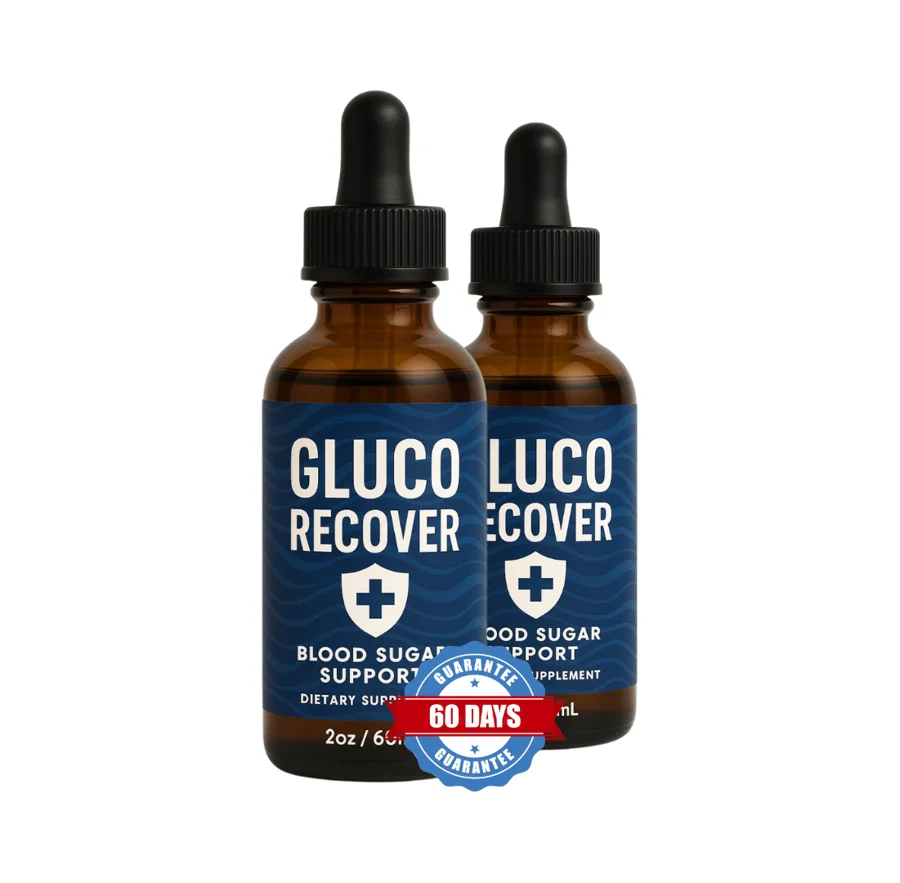
The bottle reads "GLUCO RECOVER" and describes the contents as a "Blood Sugar Support Dietary Supplement". Online the brand alternates between "GlucoRecover™" and "Gluco Recover®", and the website footer credits "Gluco Recover Research". The product is a liquid sold in a 60 ml (2 fl oz) amber glass bottle with a dropper. An older label render reads "20oz / 60ml", a typo.
The label names the distributor only as "GLUCO RECOVER" with the email support@glucorecover.com; no company name, street address or phone number appears on it. The contact page states that the drops are made in the United States in an "FDA registered and GMP certified facility" from "pure plant ingredients and natural minerals". Registration covers the facility, not the product; the FDA does not approve supplements or confirm that they work.
Two contact-page details stand out. One FAQ answer says the formula "has provided amazing energy support", wording apparently reused from an energy product. And the listed phone number is +1-000-000-0000, a placeholder, so email is the only working contact the brand publishes.
What the GlucoRecover Label Actually Shows
Here is what the GlucoRecover Supplement Facts panel contains:
- Serving size: 1 ml, with 60 servings in each bottle.
- Chromium (as chromium picolinate): 0.7 mcg per serving, which the label lists as 2% of the Daily Value.
- Proprietary Herbal Blend, 200 mg: 22 named ingredients, no individual amounts.
- Other ingredients: deionized water, organic citrus extract, natural flavors, stevia (steviol glycosides) and xylitol.
- Directions: adults take 1 ml (about two droppers full) twice daily, or as a healthcare professional directs.
- Cautions: do not exceed the dose; not for under-18s or pregnant or nursing mothers; consult a physician first, especially if you take medication; do not use if the seal is damaged.
The chromium amount is tiny: the Daily Value is 35 mcg, and glucose studies of chromium generally used 200 to 1,000 mcg. The blend is thin too. Even at the full 2 ml a day it totals 400 mg, under 20 mg per ingredient on average, and because it is proprietary nobody outside the company knows how much of it the better-studied botanicals make up.
Dosing matters for cost as well. At the labeled 1 ml twice a day you use 2 ml daily, so one 60 ml bottle lasts about 30 days. Remember that when reading the bundle labels below.
Guaraná and green tea both supply caffeine, but the label gives no total, so stimulant-sensitive buyers cannot tell how much they are taking.
GlucoRecover and Sugar Defender: Same Formula?
On paper, yes. Side by side, the two Supplement Facts panels match line for line: the same 1 ml serving and 60 servings per bottle, the same 0.7 mcg of chromium, the same 200 mg blend with the same 22 ingredients listed in the same order, and the same other ingredients. The bundle prices on the GlucoRecover order page ($158, $207 and $294) are also identical to Sugar Defender's.
There is one documented difference: the Sugar Defender label says 1 ml a day, while the GlucoRecover label says 1 ml twice daily, so a GlucoRecover bottle is meant to run out in roughly half the time. The two products also use different brand names, websites and support emails. We do not know whether the same company is behind both, and nothing on either site says so. See our Sugar Defender review, or read a side-by-side comparison.
How GlucoRecover Is Said to Work: Claim vs Evidence
The packaging sells GlucoRecover as "blood sugar support", implying that a broad mix of plant extracts, a trace of chromium and several amino acids will together nudge glucose in a healthier direction.
The research does not support anything that broad. Only a few of the ingredients, mainly Asian ginseng, gymnema and chromium, have been studied for blood sugar, and even those results are small or inconsistent. Most of the rest come from weight-loss and sports formulas, with little or no glucose evidence. We could find no published clinical trial of the GlucoRecover formula itself; any benefit is extrapolated from single-ingredient studies at far higher doses.
The NCCIH puts it plainly: most supplements sold for diabetes lack good evidence of benefit, and for a few the evidence is weak.
GlucoRecover Ingredients and What the Research Says
1. Chromium Picolinate (0.7 mcg)
Chromium is a trace mineral that plays a part in insulin signaling. The NIH Office of Dietary Supplements describes trials of chromium supplements in type 2 diabetes as producing mixed findings, and a 2016 systematic review in Nutrition Reviews judged the evidence for glycemic benefit to be limited. With less than 1 mcg per serving, GlucoRecover supplies a fraction of what those trials used.
2. Asian Ginseng (Panax ginseng) Root
Panax ginseng has the most glucose research of any botanical here. A 2014 meta-analysis of randomized trials in PLoS One reported a modest drop in fasting blood sugar, though the NCCIH still considers the overall picture unsettled. That glucose effect matters for anyone on diabetes medicine, and ginseng may interact with warfarin.
3. Gymnema (Gymnema sylvestre) Leaf
Gymnema is an Indian climbing plant whose leaves briefly block the taste of sweetness. A few small, loosely controlled human studies from decades ago reported better glucose markers. The NIH LiverTox database records rare cases of liver injury associated with gymnema supplements.
4. Eleuthero and Astragalus Roots
Eleuthero, sometimes sold as "Siberian ginseng" even though it belongs to a different genus, is marketed as an adaptogen for stamina and stress. Astragalus is a staple of traditional Chinese herbal practice. Neither has convincing human evidence for blood sugar control.
5. Maca Root and African Mango
Maca is an Andean root used mainly for energy, mood and libido, and research on it does not address glucose in any meaningful way. African mango (Irvingia gabonensis) gained attention through a few small weight-loss trials; a systematic review judged them too few and too flawed for firm conclusions.
6. Guaraná Seed and Green Tea Leaf (Caffeine Sources)
These make GlucoRecover a caffeinated product. Green tea catechins show small, uneven effects on glucose and weight. Tolerance is the bigger issue: people with high blood pressure, a heart rhythm condition, anxiety or insomnia, and anyone already drinking several cups of coffee a day, should treat it as a stimulant.
7. Coleus Forskohlii and Bird Pepper (Capsicum)
Coleus is the source of forskolin, a compound sold for fat loss with only a few small human trials behind it. Forskolin may lower blood pressure, which could matter if you already take blood pressure medicine. Bird pepper, a capsicum extract common in metabolism formulas, has thin glucose evidence.
8. Monoammonium Glycyrrhizinate (Licorice)
This is a licorice-derived compound often used as a sweetener. According to the NCCIH, glycyrrhizin taken in large amounts or for long periods can raise blood pressure and lower potassium, and it may interact with diuretics, heart drugs and blood pressure medicines. The amount here is undisclosed.
9. Grape Seed, Grapefruit Seed and Raspberry Ketones
Grape seed extract has been studied mostly for blood pressure. Grapefruit seed extract has no meaningful glucose research, and raspberry ketones rest almost entirely on animal work.
10. The Amino Acids: L-Glutamine to L-Carnitine
The second half of the blend is a group of amino acids and related compounds: L-glutamine, L-tyrosine, L-arginine, beta-alanine, GABA, L-ornithine, L-tryptophan and L-carnitine. L-carnitine has some research on fasting glucose at doses measured in grams, far above what this blend can hold. L-tryptophan is involved in serotonin production, so anyone taking an antidepressant should ask a pharmacist before combining the two.
Want to read the full GlucoRecover label yourself? The official site shows it alongside the current bundles.
Visit the Official GlucoRecover Website →Pros and Cons of GlucoRecover
Pros
- Liquid drops, handy if you dislike capsules
- Full Supplement Facts panel is published
- Contains Asian ginseng and gymnema, the two botanicals with the most glucose research
- Made in the USA in an FDA-registered, GMP-certified facility, according to the contact page
- One-time payments with no subscription, and $0.00 shipping on the 3- and 6-bottle bundles
- 60-day refund window that, per the shipping page, includes empty and partly used bottles
Cons
- 0.7 mcg of chromium is far below the doses used in research
- 22 ingredients share a 200 mg proprietary blend with no individual amounts
- 2-bottle bundle labeled a 30-day supply despite twice-daily dosing
- Contains caffeine from guaraná and green tea, total amount not disclosed
- Some ingredients may add to the effect of diabetes medication
- Refunds need an RMA, all bottles returned at your cost
- Two different return addresses and conflicting boilerplate in the policy pages
- No working phone number; email is the only real contact
Who Might Consider GlucoRecover, and Who Should Not
GlucoRecover could be a reasonable trial for adults who:
- have normal or borderline glucose readings and are already working on food, movement, sleep and weight
- do not take glucose-lowering medicine, or have cleared the product with their doctor
- prefer drops to pills and handle caffeine without problems
- accept limited evidence and will follow the refund steps if needed
It is not a good fit, or should only be used with medical approval, for people who:
- use insulin, metformin, sulfonylureas or any other diabetes medicine
- are under 18, pregnant or nursing (the label excludes these groups)
- have high blood pressure, a heart rhythm disorder, or kidney or liver disease
- take blood thinners, blood pressure drugs, diuretics or antidepressants
- react badly to caffeine or already sleep poorly
Constant thirst, frequent urination, blurry vision, unplanned weight loss or slow-healing cuts are reasons to get tested by a doctor, not to order a supplement.
GlucoRecover Safety, Side Effects and Medication Cautions
There is no published safety data on GlucoRecover as a finished product, which is not the same as proof of safety. From the ingredients, the likeliest problems are an upset stomach, jitteriness, a racing heart or poor sleep from the caffeine sources, and headaches. If anything new appears, stop and talk to a health professional.
The central safety issue is stacking with diabetes medication. Ginseng, gymnema and chromium are all thought to have some glucose-lowering potential, and combined with insulin or sulfonylureas they could contribute to hypoglycemia. MedlinePlus lists the warning signs of low blood sugar: shakiness, sweating, hunger, confusion, a fast heartbeat and, in severe cases, loss of consciousness. If your doctor agrees to a trial:
- keep taking prescribed medicine exactly as directed and never adjust it on your own
- test your glucose more often during the first weeks
- carry a quick source of sugar and know how to treat a low
- make sure your doctor and pharmacist know every supplement you use
- measure any effect with meter readings or lab results rather than how you feel
The licorice compound and caffeine matter for high blood pressure or heart disease, and ginseng may interact with blood thinners. The formula also contains xylitol, which is fine for people but dangerous for dogs, so keep the bottle where pets cannot reach it. For a closer look at each component, see our ingredient-by-ingredient safety guide.
How to Use GlucoRecover
Per the label, adults take 1 ml (about two droppers full) twice a day unless a healthcare professional advises otherwise. The label gives no advice on timing or food. Do not exceed the labeled amount.
To judge it fairly, record a baseline fasting glucose (or A1C) first, take it consistently and recheck when your doctor suggests. The refund window closes 60 days after purchase, so decide, and start any return, well before then.
GlucoRecover Price, Shipping and Guarantee
The official order page offers three bundles, each charged once with no subscription mentioned. These are the totals we saw at checkout on October 13, 2026:
| Bundle | What we saw at checkout (Oct 13, 2026) |
|---|---|
| 2 bottles (about 60 days at 2 ml/day) | $79 per bottle, $158 + $9.90 shipping = $167.90 total, $0.00 tax |
| 3 bottles (about 90 days) | $69 per bottle, $207 total, $0.00 shipping |
| 6 bottles (about 180 days) | $49 per bottle, $294 total, $0.00 shipping |
| Guarantee | 60 days from the purchase date, after an RMA from support |
| Carrier | UPS listed as primary; some policy lines mention USPS |
| Processing | 1 to 2 business days, shipping Monday to Friday; US delivery time not stated |
Supply estimates are ours, based on the twice-daily dose. The order page calls the 2-bottle bundle a "30 Day Supply", which does not fit that dose. International delivery takes 4 to 6 weeks, occasionally 8 to 12. Orders can be cancelled only within 24 hours of purchase.
What We Saw on the Official GlucoRecover Order Page (October 13, 2026)
On October 13, 2026 we opened the official order page ourselves and followed the checkout up to the payment step, without placing an order, so we could record what a buyer actually sees. The screenshots below are unedited crops from that visit.
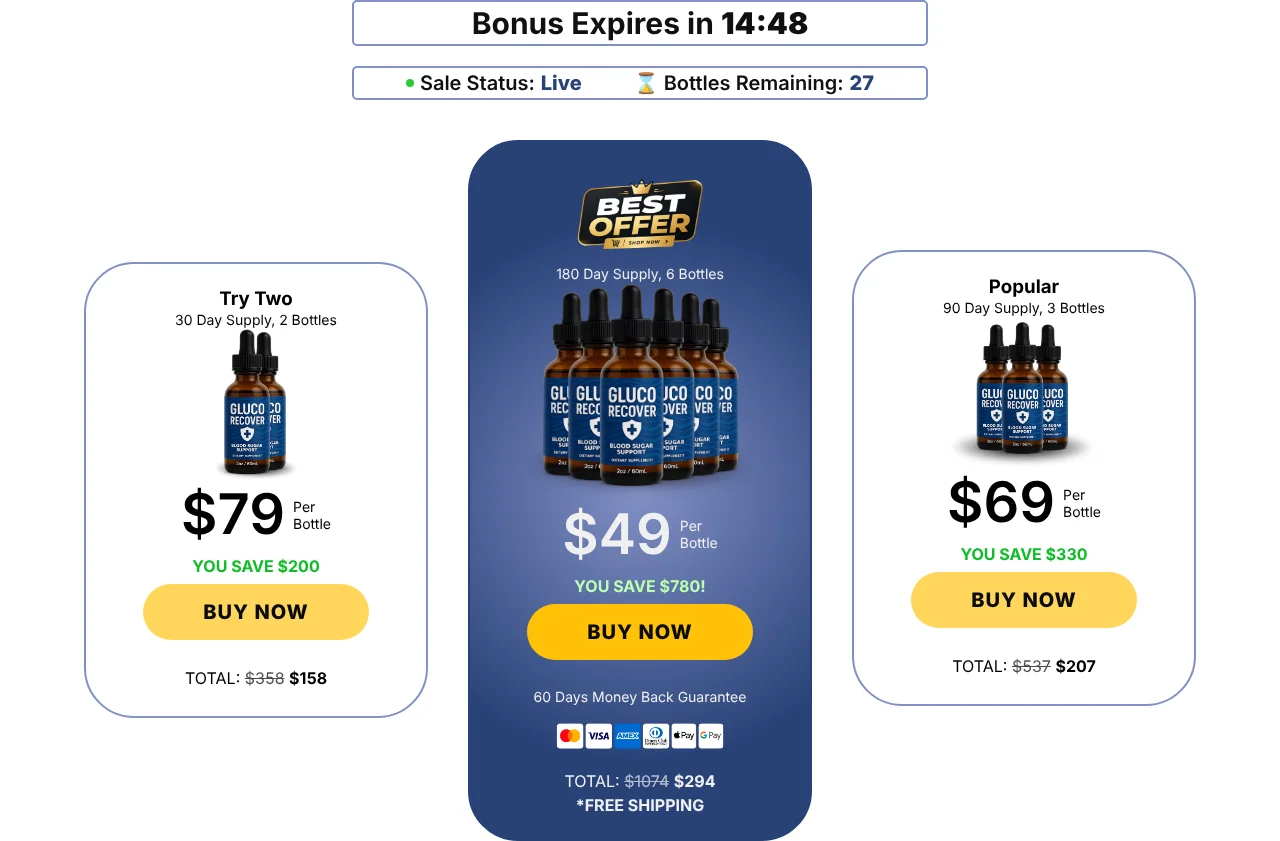
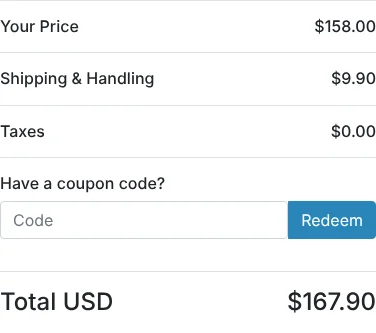
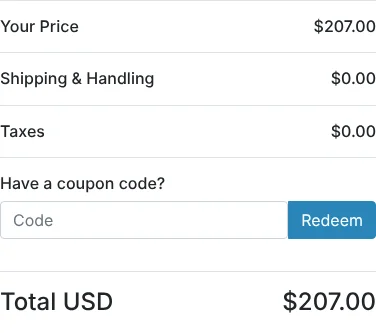
- The order page listed 2 bottles at $79 each ($158), 3 bottles at $69 each ($207) and 6 bottles at $49 each ($294), each beside a crossed-out higher price.
- The 2-bottle checkout added $9.90 for shipping, for a total of $167.90 with $0.00 tax. The 3-bottle checkout showed $207 with $0.00 shipping.
- A "Bonus Expires in 15:00" countdown timer ran on the page, although we found no description of any bonus.
- A "Bottles Remaining: 27" counter was displayed. Both are sales-pressure devices; do not let them rush you.
- The bare domain, glucorecover.com, showed a different price grid ($79, $59 and $49 per bottle, with 3 bottles at $177). Its buttons led to a checkout that said "This offer is no longer available", so the price that counts is the one shown at checkout.
Refund Policy: What You Must Do to Get Your Money Back
The 60-day window comes with conditions. In order:
- Email support@glucorecover.com and get a return authorization (RMA) approved within 60 days of the purchase date, not the delivery date.
- Ship the product back within 14 days of receiving the RMA, at your own cost and with tracking.
- Return every bottle, whether empty, full or partly used, including any free or bonus bottles. Missing bottles lead to a partial refund.
- Put a note inside the package with your order ID, full name and address, email, phone number and the packing slip.
- Email the RMA number and tracking number to support once the parcel is on its way.
- Make sure the package arrives within 60 days of the original purchase date.
There is a complication: the brand publishes two different return addresses. The return-policy page gives one in Aurora, Colorado, while the shipping page gives one in Orlando, Florida, to be sent by USPS. Ask support in writing which one to use before mailing anything, and keep the reply.
The return-policy page also carries template text saying "only regular priced items may be refunded, unfortunately sale items cannot be refunded". That wording conflicts with the 60-day promise, and every bundle is shown at a discount, so get refund eligibility confirmed by email. Also: if you refuse a delivery, the shipping fee is deducted from any refund, and no refund is given when tracking shows a parcel as delivered.
Where to Buy GlucoRecover, and How to Avoid Lookalike Sites
Searches turn up many similar domains, such as gluco-recover.net, glucorecover.net, glucorecover-us.com, glucorecover-web.com, www-glucorecover.com, gluco--recover.com and en-en-us-glucorecover.com. We cannot tell who runs them. The one whose policy pages and support address match the bottle label is glucorecover.com, with support@glucorecover.com.
A few checks before you pay:
- read the address bar carefully, since several lookalikes differ by a hyphen or a prefix
- confirm that the support email on the site matches the one printed on the label
- only enter card details on a secure order page that shows the bundle price and shipping before payment
- skip marketplace listings; one eBay listing offers "Gluco Recover" as 60-count pills, a different form from the dropper bottle on the official site
For a step-by-step walk-through of ordering, see our guide to buying from the official site.
→ Check the current GlucoRecover price on the official order page
Final Verdict
GlucoRecover is a liquid with a long, fully listed ingredient panel, and as far as the label goes it is the same formula as Sugar Defender, with directions that double the daily amount. That transparency is useful, but it also reveals the weak spots: a chromium dose too small to matter, a 200 mg proprietary blend split across 22 ingredients, undisclosed caffeine, and no trial of the product itself.
The buying process needs care too: a countdown timer, a stock counter, a placeholder phone number, two return addresses and contradictory policy text. For an adult without diabetes who wants to try it alongside healthy habits, it can be a measured experiment if you track real numbers and document the refund steps. If you take medication for blood sugar, talk to your doctor first, and never let a supplement replace prescribed treatment.
Frequently Asked Questions (FAQs)
Has the FDA approved GlucoRecover?
No. The FDA does not approve dietary supplements before sale. The brand says GlucoRecover is made in an FDA-registered, GMP-certified facility in the US, which concerns manufacturing standards, not proof that the product works.
Is GlucoRecover the same as Sugar Defender?
The labels match: same serving size, 0.7 mcg of chromium, 200 mg blend of 22 ingredients in the same order, and same other ingredients. GlucoRecover says 1 ml twice daily; Sugar Defender says 1 ml a day. We do not know if one company makes both.
Can I take GlucoRecover with metformin or insulin?
Only if your doctor agrees. Ginseng, gymnema and chromium may lower blood sugar and could add to the effect of diabetes medicines, raising the chance of a low. Do not change your medication on your own.
How long does one bottle of GlucoRecover last?
At the labeled dose of 1 ml twice a day, a 60 ml bottle lasts about 30 days. That means the 2-bottle bundle covers roughly two months, even though the order page calls it a 30-day supply.
Does GlucoRecover contain caffeine?
Yes. Guaraná and green tea are both natural caffeine sources. The label does not state how much caffeine a serving provides.
How do I get a GlucoRecover refund?
Email support@glucorecover.com for an RMA within 60 days of purchase, ship all bottles back at your cost with tracking within 14 days, include a note with your order details, and email the RMA and tracking number. Confirm the return address in writing first.
Why do I see different GlucoRecover prices online?
On October 13, 2026 the order page showed $158, $207 and $294 for 2, 3 and 6 bottles, while the domain root showed another grid whose checkout said the offer was no longer available. Lookalike sites may show other prices. Go by the total shown at checkout.
Ready to compare the GlucoRecover bundles? The official order page shows the current checkout totals.
Visit the Official GlucoRecover Website →References
- NIH Office of Dietary Supplements. Chromium: Fact Sheet for Health Professionals.
- NIH Office of Dietary Supplements. Dietary Supplements for Weight Loss: Fact Sheet for Health Professionals.
- National Center for Complementary and Integrative Health (NCCIH). Diabetes and Dietary Supplements: What You Need To Know.
- NCCIH. Asian Ginseng.
- NCCIH. Licorice Root.
- NCCIH. Green Tea.
- Costello RB, Dwyer JT, Bailey RL. Chromium supplements for glycemic control in type 2 diabetes: limited evidence of effectiveness. Nutr Rev. 2016;74(7):455-468.
- Shishtar E, Sievenpiper JL, Djedovic V, et al. The effect of ginseng (the genus Panax) on glycemic control: a systematic review and meta-analysis of randomized controlled clinical trials. PLoS One. 2014;9(9):e107391.
- Onakpoya I, Davies L, Posadzki P, Ernst E. The efficacy of Irvingia gabonensis supplementation in the management of overweight and obesity: a systematic review of randomized controlled trials. J Diet Suppl. 2013;10(1):29-38.
- NIH LiverTox: Clinical and Research Information on Drug-Induced Liver Injury. Gymnema Sylvestre.
- MedlinePlus. Low blood sugar (hypoglycemia).
This review is for general information only and is not medical advice. Product details (ingredients, prices, guarantee) come from the official GlucoRecover pages as checked in October 2026; they can change, so confirm them at checkout. Talk to your doctor before starting any supplement, especially if you take prescription medication or have a health condition.